The phrase "Icelandic botanicals" is already at risk of becoming shorthand for something marketing does on a label. That is a pity, because the underlying case, stripped of the adjectives, is unusually rigorous.
Icelandic flora grow in conditions that force plants to produce elevated concentrations of secondary metabolites. Long photoperiods above the Arctic Circle. Near-continuous UV exposure in summer. Mineral-dense volcanic soils. Windswept, low-nutrient substrates in exposed coastal and highland terrain. Plants under this kind of environmental pressure do not survive on bulk growth. They survive by producing more terpenes, more flavonoids, more specialised defensive compounds than the same species growing in milder conditions further south.
For a cannabinoid formulation, that phytochemistry is not decorative. It is a second active layer that compounds with the cannabinoid pharmacology. The question worth asking is not whether Icelandic-sourced botanicals are better in a marketing sense, but whether the specific secondary metabolites in a specific set of species do meaningful pharmacological work alongside CBD, CBG, and the minor cannabinoids. The answer, for a small number of species, is yes.
Three actives that do real work
The whitepaper walks through nine Icelandic species. Three of them illustrate the principle most clearly.
Angelica archangelica
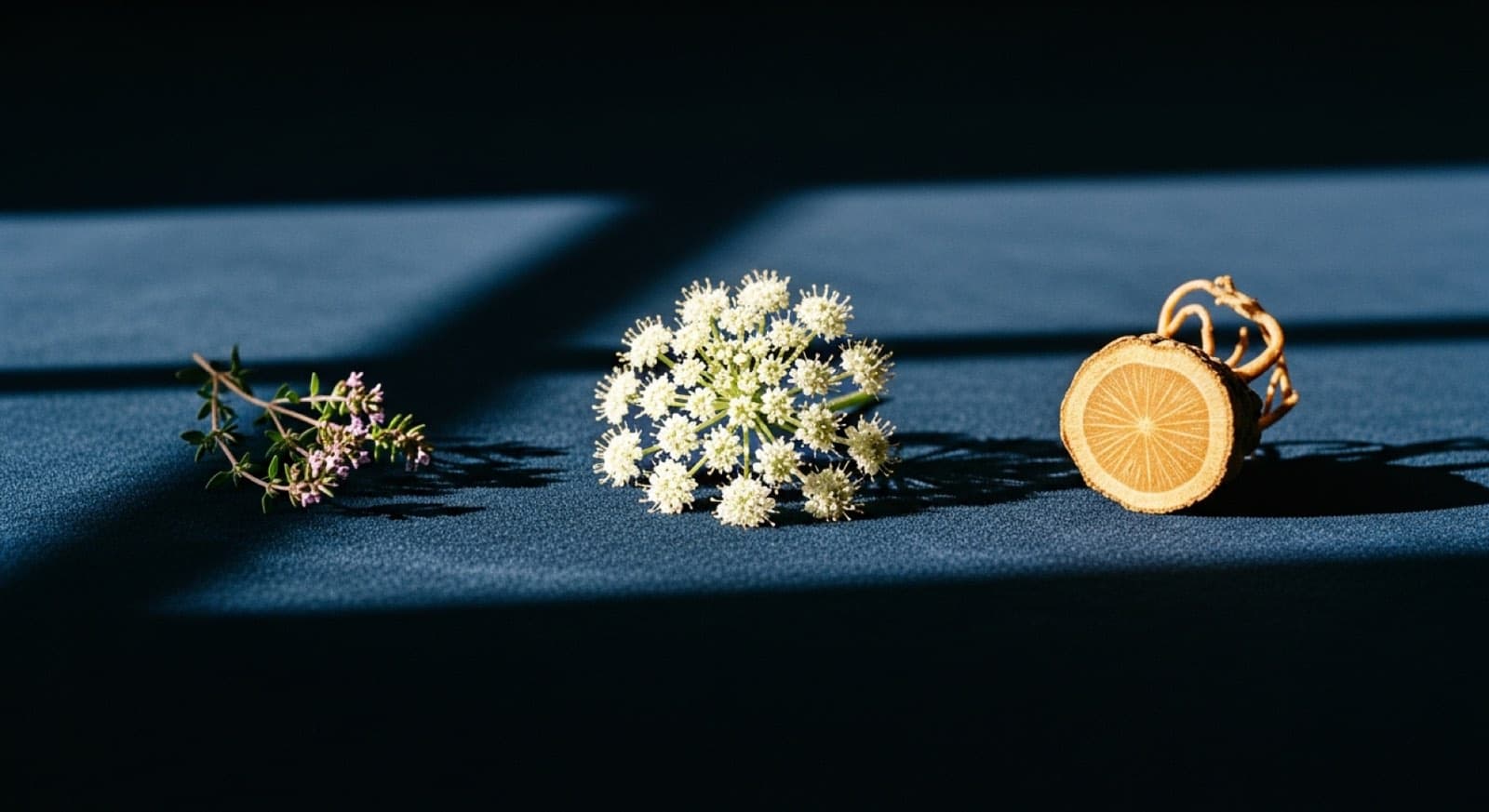
Angelica archangelica contains coumarins, furanocoumarins, and a complex essential oil profile dominated by alpha-pinene, beta-phellandrene, and limonene. The clinical literature supports its use in mild gastrointestinal spasm and smooth muscle regulation, and the in vitro work points to an anti-inflammatory effect through COX-2 modulation. The terpene profile overlaps with the cannabinoid-entourage literature in ways that formulators should take seriously rather than in passing.
In Icelandic traditional medicine, angelica has been in continuous medicinal use since the monastic period. That provenance is worth mentioning because it shortens the regulatory case for a product that combines it with cannabinoids in a wellness context.
Arctic thyme, Thymus praecox
The compact Arctic thyme that grows across Icelandic lava fields contains higher concentrations of thymol and carvacrol than cultivated thyme varieties from warmer latitudes. Both compounds have well-characterised antimicrobial and anti-inflammatory activity, and both appear in the peer-reviewed literature alongside studies on smooth muscle relaxation and respiratory function. In a cannabinoid formulation targeting inflammatory pelvic pain, that profile is not filler. It is complementary pharmacology.
Rhodiola rosea
Rhodiola rosea is the most studied adaptogen in the Nordic pharmacopoeia. Icelandic-grown rhodiola is particularly high in rosavins and salidroside, the two compound classes most consistently linked in randomised trials to improvements in fatigue, cognitive performance under stress, and mild depressive symptomatology. In perimenopausal formulation work, where the endocannabinoid literature converges with hypothalamic-pituitary-adrenal-axis signalling, rhodiola is one of the more defensible non-cannabinoid additions a formulator can make.
What synergy actually means here
"Synergy" is one of those words the industry uses loosely. In a formulation context it has a narrow pharmacological meaning, which is that two compounds produce a larger effect in combination than the sum of their effects in isolation. That is not what most cannabinoid plus botanical products are achieving today.
What the better-constructed products are achieving is complementary pharmacology. The cannabinoid acts on CB1 and CB2 receptors and related targets. The botanical acts on COX-2, TRPV1, smooth muscle, HPA axis, or the microbiome, depending on the species. Together, they cover a broader symptom domain than either would on its own. That is not synergy in the strict sense, but it is the formulation logic that matters for operators building serious products.
Where actual pharmacological synergy has been demonstrated, it tends to be in the terpene literature, where specific monoterpenes modulate cannabinoid receptor binding or the downstream intracellular response. That is a tighter claim, and a harder one to defend commercially without trial data. Most formulators should stay on the complementary-pharmacology side of the line and be disciplined about what they say on the label.
The question worth asking is not whether Icelandic-sourced botanicals are better in a marketing sense, but whether the specific secondary metabolites in a specific set of species do meaningful pharmacological work alongside the cannabinoids.
Why this matters commercially
Three implications follow, for operators who are thinking past the first product launch.
- Differentiation that survives scrutiny. A cannabinoid-plus-botanical product with a defensible formulation rationale is meaningfully harder to copy than a single-active CBD tincture. The barrier is not the cannabinoid. It is the botanical sourcing, the supplier relationships, and the formulation work that connects the two.
- Label integrity matters more every quarter. UK and EU regulators are tightening what a label can say. Products built on a pharmacologically coherent combination of ingredients have a clearer regulatory pathway and a better position in any future compliance review than products built on marketing language.
- The clinical conversation gets easier. Clinicians who will not take a single-active CBD supplement seriously will often take a formulated product seriously, provided the formulation logic is visible and the actives are in clinically rational concentrations.
A practical note
The nine botanicals in the Icelandic Elements whitepaper were not chosen for their provenance alone. They were chosen because each one contributes pharmacology that is complementary to the cannabinoid backbone, documented in peer-reviewed literature, and available at commercial scale through an Icelandic supply chain that is more organised than most operators realise.
The 2026 Icelandic Elements whitepaper sets out the full formulation framework, the clinical rationale for each botanical, and the commercial model for bringing this kind of product to market in the UK, Germany, and the Nordics over the next thirty-six months.
If you work in formulation, distribution, or clinical practice, and you want to talk through how this applies to a specific product or channel, I would be glad to hear from you.